Volume against strict turnaround
High image volume with tight SLAs required structured batch workflows and defined daily throughput targets.

Reliable Remote Staffing
Since 2004
Client success story · CS28
Visual consistency validation for a large multi-category retailer
A large-scale multi-category retailer across home furnishings, lifestyle and interior décor, with an active catalog exceeding 100,000 SKUs, had invested heavily in generative AI tooling to produce product variants at scale.
AI generation introduced a new category of risk. Without a validation layer, generated images were reaching the catalog with warped geometry, colour drift from the reference image, backgrounds violating brand guidelines and structural artifacts.
Problem
For a business where the product image is the primary trust signal, and where a customer cannot sit on a sofa before buying it, visual consistency is commercial rather than cosmetic. A single inconsistency in colour, geometry or background erodes confidence, inflates returns and degrades catalog integrity.
The programme had to validate every generated image against a clearly defined standard, at the volume and speed the catalog operation demanded.
High image volume with tight SLAs required structured batch workflows and defined daily throughput targets.
Maintaining annotation consistency across 25+ people needed a standardised SOP with visual examples per defect category, daily calibration and inter-annotator agreement tracking.
Modular sofas, detachable chaises and irregular orientations needed dedicated guidelines with illustrated decision trees — L- and U-shaped sofas received flexible pose rules, detachable components assessed for structural plausibility rather than exact replication.
Explicit rule-of-thumb logic was embedded in the SOP: any element not explicitly allowed was treated as forbidden, with borderline cases escalated to a senior QA reviewer within the same shift.
Solution
Detailed SOPs covered all quality parameters with clear criteria and visual examples, so image evaluation was consistent and objective rather than dependent on individual judgement.
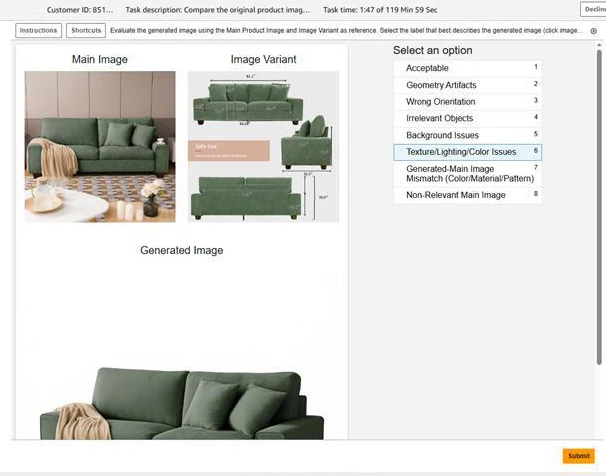
Each annotator worked with a three-image set — the main product image as reference, the image variant as secondary reference, and the generated image under evaluation — using both references to assess geometry and colour, texture and material compliance so no single reference point introduced bias.
Each generated image was assessed against ten structured quality dimensions with explicit pass/fail criteria: geometry, visibility, colour accuracy, material fidelity, pose, background compliance, object count, allowed versus forbidden elements and artifact detection.
Non-compliant images were labelled with standardised defect categories — geometry artifacts, wrong orientation, background issues, texture and colour issues, generated-to-main mismatch — enabling tracking and reprocessing, and giving the client's AI team attributable failure modes rather than a rejection count.
Each image was independently audited by three different auditors, with further sampling validation by senior QA specialists and full re-review triggered when error rates exceeded predefined thresholds.
Workflow
Every image moved through six controlled stages inside AWS SageMaker, giving end-to-end traceability from batch intake to production-ready delivery.
Setup
Impact
Impact
The audit was commercial rather than cosmetic, and the document records its effect on the buying decision itself.
Generative tooling changed the cost of producing product imagery and not the cost of getting it wrong. The value here was the validation layer: a written rubric, three independent audits per image, and defect tagging structured so the client could fix the generation model rather than keep rejecting its output.
Describe it in a sentence. We will tell you what we would do about it, and whether it is something we should be doing at all.
Tell us the workload
We will map the roles, the hours and the cost, and come back within one working day.
Or submit an enquiry — the full form, with a service line