How it works

How StaffCloud works

How an account is set up before any work begins, what is agreed in writing, and the cycle it settles into once it is running. The model decides who is assigned and how capacity is agreed — not what the work costs, which is quoted per engagement.

  • 4 models
  • Scoped on a sample
  • Six steps once live

The four models

Most accounts start on one and move to another as the volume settles.

Dedicated team

Named people working only your account, on your systems, to your SOPs. The model behind every client story on this site.

  • Best for ongoing operational work with a steady volume
  • You know who they are; they learn your catalogue and your exceptions
  • Cross-trained cover so a leave day is not an outage
Shared capacity

A share of a pod rather than whole people — for work that is real but does not fill a desk.

  • Best for a queue that peaks rather than runs constantly
  • Same named leads, capacity agreed per week
  • Scales into a dedicated team when the volume justifies it

Project engagement

A defined scope with a start and an end: a catalogue migration, a backlog clearance, a one-off audit.

  • Best for a piece of work with a finish line
  • Scoped against a sample before anything is committed
  • Handover documentation at the end, not just a delivered file

Pilot

A small, time-boxed run on your real data before either side commits.

  • Best when accuracy or turnaround is the open question
  • Baselines are measured on your account, not quoted in advance
  • Ends with the numbers, whichever way they came out

How an engagement starts

Four steps, in this order, before anyone is assigned.

  1. 01

    Scoping call

    What the work is, what systems it lives in, what good looks like.

  2. 02

    Sample run

    A slice of real work, so the estimate is measured rather than guessed.

  3. 03

    Team and SOP

    Named people assigned, the SOP written down and agreed with you.

  4. 04

    Baseline and report

    The first weeks set the baseline; reporting runs against it.

The four commercial questions

What a buyer asks before anything else. The rate itself is quoted per engagement; everything around it is answered here. Clause numbers refer to the Terms and Conditions, which govern — and where a Service Agreement says something different, the Service Agreement wins.

Most accounts are priced per dedicated team member, per month, by role and by the hours covered — a catalogue associate, a Vendor Central specialist and a reporting analyst are not priced the same because the training and oversight differ. Hourly, milestone, fixed-price, transaction and retainer bases are all available where the shape of the work suits them better.

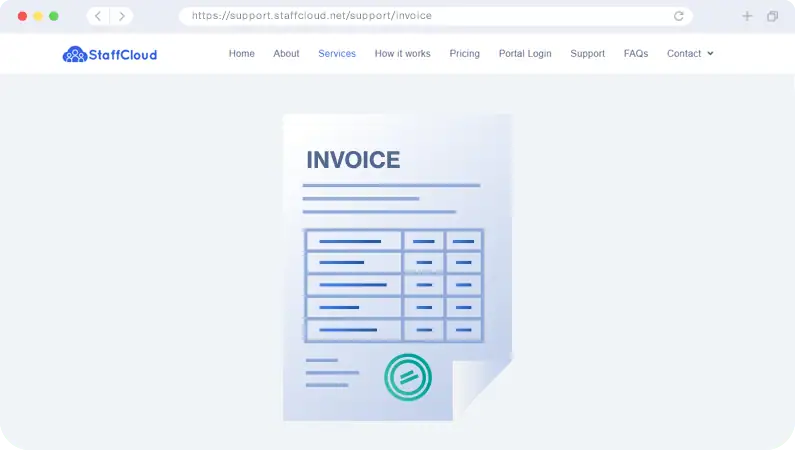
There is no setup fee. After a scoping call you get a written quote naming the roles, the shift pattern and the monthly cost, in a form you can hand to your finance team. Invoices are payable within thirty days.

Three to four weeks is typical: about a week to document your workflow, one to two to recruit or reassign and train against it, and a supervised first week on live work before the team runs unaided.

Where the process is already documented and system access is ready, we have started inside ten working days. The constraint is almost never recruitment — it is how long it takes to write down what good looks like, which is why that step is not compressed.

Operationally: every process has a written QA rubric agreed before go-live, and the error rate is reported alongside the work rather than on request. If quality slips, StaffCloud retrains or replaces at its own cost.

Contractually, the remedy is to re-perform the service or correct the deliverable within a reasonable time, and where that is not commercially practicable, to refund the fees paid for the non-conforming part (Terms 20.2). That is the exclusive remedy for a breach of the service warranty.

Either side may end a Service Agreement for convenience on sixty days' written notice, unless that agreement sets a different period (Terms 23.2). Either side may end it immediately for a material breach the other has not fixed within thirty days of being told about it (23.3).

On termination you pay for work performed up to that date, and where you terminate for convenience, the notice-period fees for assigned people remain payable — they are salaried staff, not contractors who can be stood down. Transition assistance is available for up to thirty days afterwards (23.4).

What is agreed in writing

Before the work starts

  • The scope, and what sits outside it.
  • Which systems the team works in, and under whose accounts.
  • The hours of cover, set against your time zone.
  • Who the named leads are and who escalation goes to.

Once it is running

  • A baseline measured on your own data in the first weeks.
  • Reporting against that baseline, in a format you can forward.
  • A written handover at the end of every shift.
  • A review point where the model can change if the volume has.

Still deciding?

Two places to look before you send anything.

The answers

Sixteen answers on getting started, services, the portal, payment and careers — read the FAQ.

Once it is running, in six steps

The cycle every live account repeats, from the first ticket to the monthly invoice. Nothing here is bespoke to a deal size — a three-hour task and a twelve-person account run the same way.

StaffCloud keeps an in-house team of 300+ employees, with management practices built around quality, delivery on the promised date, and cost-effectiveness.

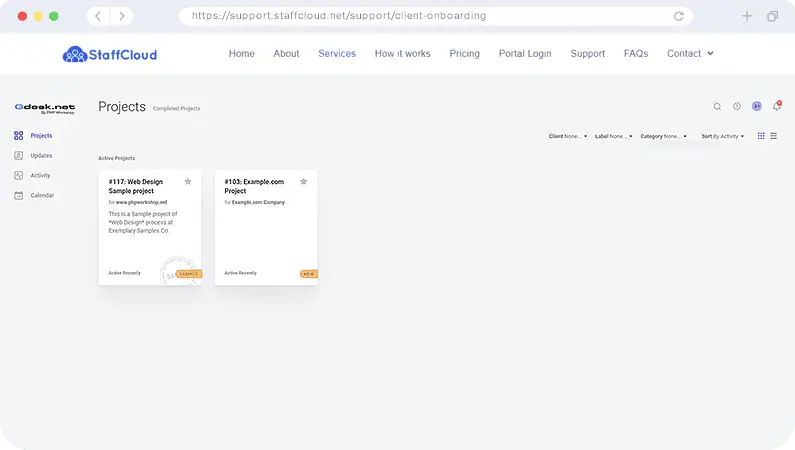
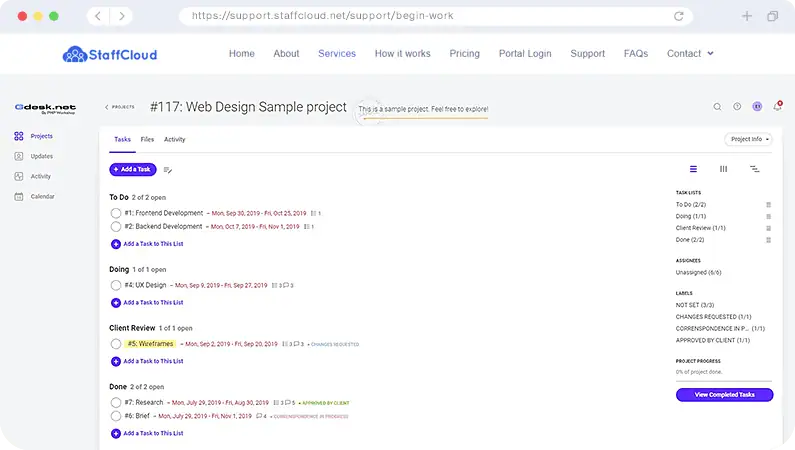
Communication runs through a task-based portal, so the client, the staff working the account and the QA team are all looking at the same thing — and backup staff can take a task over when someone is away.

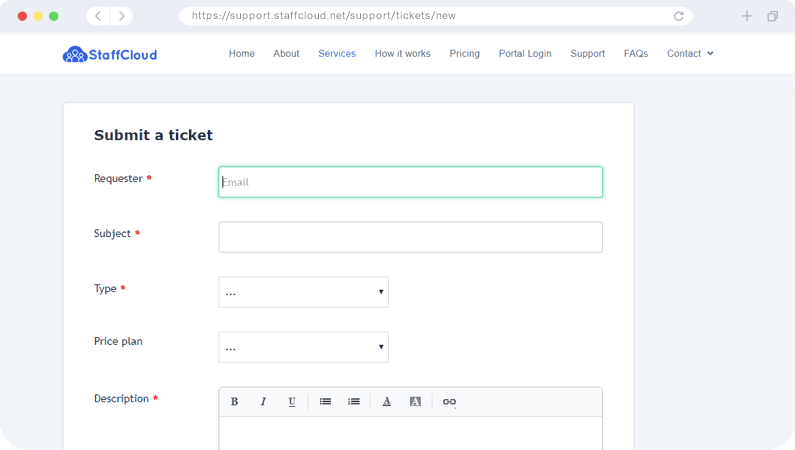
Submit a Ticket with project details.

Step 1 — Submit Ticket

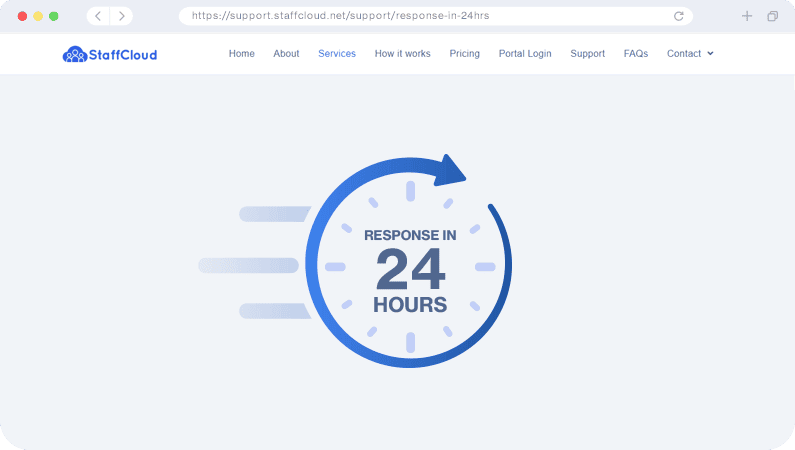
Get Price Quote and free trial work.

Step 2 — Response in 24 hrs

Client Onboarding and Complimentary portal account.

Step 3 — Client onboarding

Work started. 2-way Communication and reporting through Portal.

Step 4 — Begin work

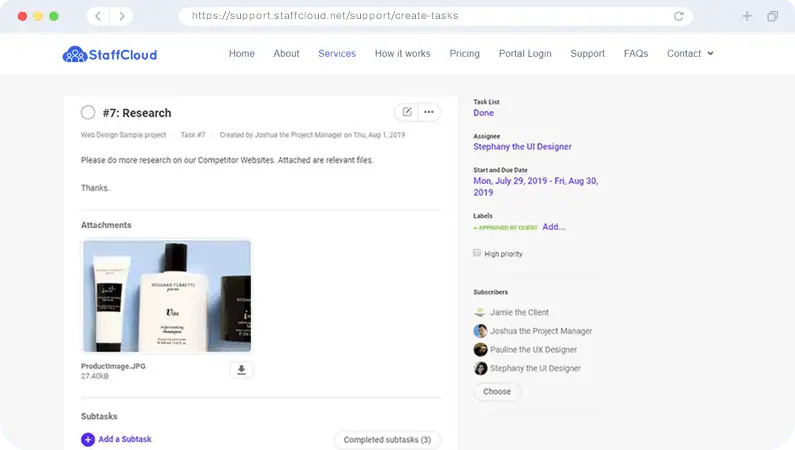
More TASKs can be created through Portal. 100% Transparency.

Step 5 — Create tasks

Invoiced Monthly.

Step 6 — Invoiced monthly

Want to see the work rather than read about it?

Every client story on this site came out of a live account — a listing nobody could unblock, a chargeback nobody had time to dispute, a support queue that had outgrown the person holding it.

WhatsApp