Opaque calculation
There was limited visibility into how provisional charges were calculated, so overlaps with standard charges could not be identified from the reporting alone.

Reliable Remote Staffing
Since 2004
Client success story · CS7
A routine deduction audit that became a financial investigation
A US industrial tools and scientific equipment brand operates Amazon Vendor Central under structured agreements covering co-op, freight and damage allowances. The agreements were active and clearly defined.
The brand nonetheless began noticing a gradual erosion in margin. The deductions did not align with expectations, and the concern was revenue leakage rather than any single disputed invoice. What started as a routine audit became a deeper investigation.
Problem
At first glance the deductions appeared valid — which is precisely why the problem had persisted. It was only when charges were compared against sales performance that the inconsistencies became visible.
The investigation then identified something more specific: provisional co-op charges were being applied alongside active agreements, creating a high risk of duplicate billing that no single report would surface.
There was limited visibility into how provisional charges were calculated, so overlaps with standard charges could not be identified from the reporting alone.
Accruals, adjustments and back-charges were interleaved across periods, which is what allowed the duplication to stay hidden.
Amazon's dispute policy restricts how far back a claim can reach, putting a deadline on an investigation that had not yet established what it was looking for.
Clarification and escalation required several different Amazon teams, none of whom owned the whole picture.
Solution
Rather than treating this as a standard deduction query, the work started by understanding how billing had behaved month to month.
The pattern that emerged was driven by timing: in certain months standard co-op charges were not applied, provisional charges were introduced as temporary placeholders, and Amazon later applied back-charges under the actual agreement for the same periods. Both provisional and standard charges therefore landed on the same transactions.
A detailed month-by-month transaction map was built covering net receipts, allowance percentages, co-op accruals and charges, provisional adjustments and the back-charges applied later — recreating the full billing lifecycle and pinpointing exactly where the overlaps occurred.
Deductions were recalculated with and without provisional charges, duplicate entries identified at invoice level, and a clean reconciliation file prepared showing the financial impact. This is the step that converted a suspicion about margin into dispute-ready evidence.
Multiple dispute claims were raised per discrepancy and later consolidated by Amazon into a single dispute ID; both were tracked in parallel with consistent follow-ups and clear timeline references. Amazon Support and Finance were engaged, and the Vendor Manager brought in for agreement validation.
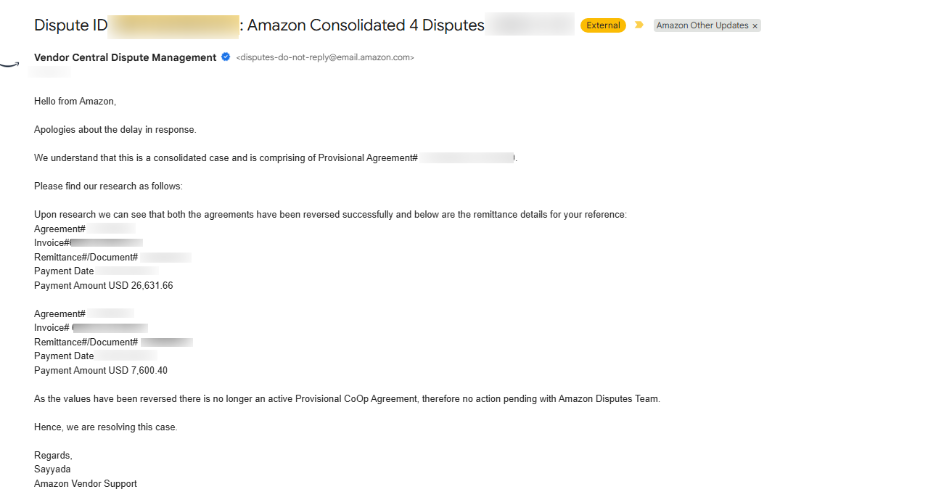
Impact
The lesson here is about detection rather than dispute. The deductions looked valid, the agreements were correct, and the loss was only visible as a slow erosion in margin. A timeline-based audit found what per-invoice checking never would have — which is the argument for looking at deduction behaviour over time rather than case by case.
Describe it in a sentence. We will tell you what we would do about it, and whether it is something we should be doing at all.
Tell us the workload
We will map the roles, the hours and the cost, and come back within one working day.
Or submit an enquiry — the full form, with a service line