Misclassified case
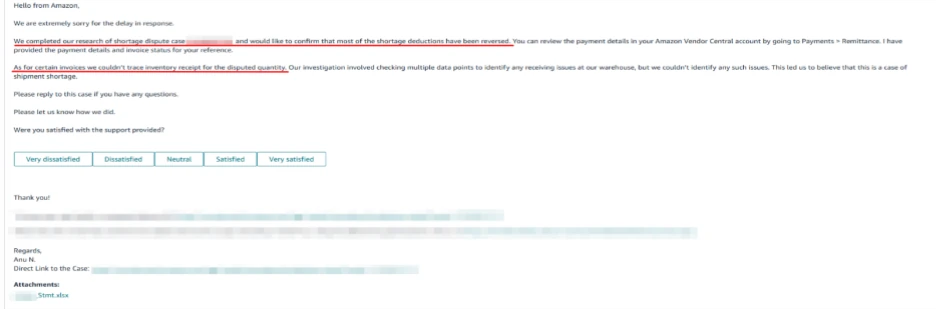
The RCA request was initially handled as a set of individual shortage claims, which is a different and much less useful process.

Reliable Remote Staffing
Since 2004
Client success story · CS6
Vendor Central disputes reworked with complete documentation
A US supplier of industrial and contractor-grade cutting tools — drill bits, taps and dies, reamers — sells through Amazon Vendor Central alongside an offline distribution network.
High transaction volumes make invoice reconciliation and timely payment central to cash flow. A block of rejected invoices, including a single disputed amount of $14,237.29, needed root-cause analysis and a structured re-dispute rather than acceptance.
Problem
A Balance Confirmation case was submitted through Vendor Central requesting a detailed RCA across all rejected invoices, with the Amazon dispute template, proof of delivery, bills of lading and supporting shipment documentation attached.
The process then ran into several structural problems rather than evidential ones.
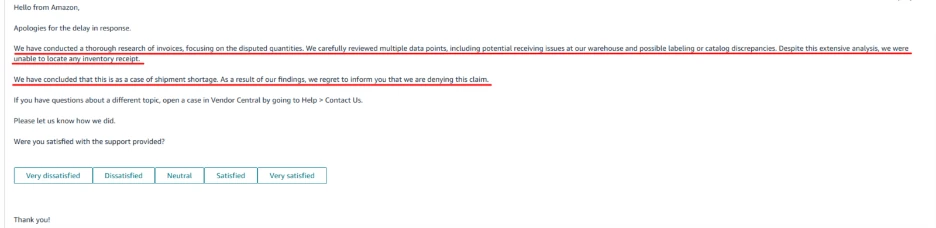
The RCA request was initially handled as a set of individual shortage claims, which is a different and much less useful process.
Payments were reversed without thorough validation against the submitted evidence.
Multiple invoices were rejected because inventory receipt records were missing or untraceable in Amazon's systems.
Delayed responses from support teams stretched resolution timelines and made progress hard to track.
Solution
The case was escalated to Amazon leadership with a request for a comprehensive root-cause analysis across all disputed invoices, rather than accepting per-invoice handling that would never surface the common cause.
Regular follow-ups maintained visibility and accountability from Amazon's internal teams. This is the unglamorous half of dispute work and the half that most often decides the outcome.
Initial RCA findings produced partial invoice approvals, which established the pattern and made the remaining cases easier to argue.
A re-dispute process was initiated for 64 rejected invoices, each with complete and corrected documentation, alignment to Amazon's dispute requirements, and clear mapping between shipment and invoice data.
All supporting documents were reviewed and resubmitted with improved accuracy to strengthen claim validation — most rejections traced back to documentation gaps rather than invalid claims.
Impact
Rejected invoices are not the same as invalid ones. A structured RCA prevented incorrect payment reversals, escalation moved the timeline, and re-dispute with corrected documentation recovered most of the value — with the remaining invoices still being worked rather than written off.
Describe it in a sentence. We will tell you what we would do about it, and whether it is something we should be doing at all.
Tell us the workload
We will map the roles, the hours and the cost, and come back within one working day.
Or submit an enquiry — the full form, with a service line